Sierra Mulepacking, August 2011
Part I, Mulepacking with the Kentuckians in Ansel Adams Wilderness
This is the best-est birthday present I've ever had: Kathie entered the lottery for a Yosemite High Sierra Camp mule packing trip, and got us in for my 50th.
I added a week for mulepacking with my friends from Kentucky, and that's two weeks of running around the Sierra - including almost a full week with my wife!
As a bonus, it turned out the first weekend offered a full moon setting at sunrise, and then rising at sunset - great photographic opportunities.
In early 2011 the west coast had an extended winter which left a deep snowpack well into summer. That meant some early Yosemite High Sierra Camp trips were cancelled.
Fortunately, Kathie had chosen the very last scheduled trip. Some camps opened just the weekend before we arrived.
We barely squeaked in...and found spring at the end of August!
Mosquitoes were a constant problem, but the wildflowers and greenery more than compensated.
Skip to the interlude between mulepacking... or the second week, mulepacking with Kathie in Yosemite.
The first night after work I zipped down to Crater Lake, and found...
...mosquitoes. Lots of mosquitoes. Earnest, single-minded mosquitoes.
With a full moon, it was a great night for sleeping out, but I had to crawl into a big bug net.
The next morning I went to Cloud Cap viewpoint to photograph the full moon setting across the lake as the sun rose behind me.
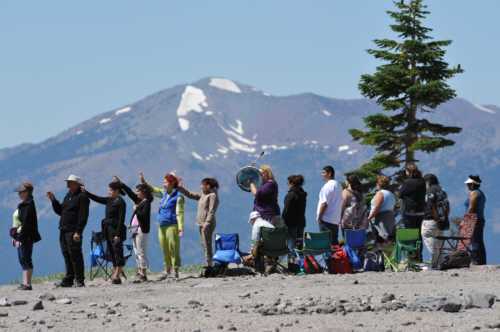
Heading south into California, I stopped by Mt Shasta for lunch on the mountain.
A bright, sunny day - too windy for mosquitoes - but plenty of other people enjoying the mountain.
Many, um, spiritual? people find the mountain...um...special.
These folks beat their drum like "Indians" from a 1950's western - thump-thump-thump-thump, thump-thump-thump-thump...
It was my first visit to Mt Shasta without skis or climbing gear, and I got to see pretty Panther Meadows just before full wildflower bloom (late summer, remember?)
Then south and east to Lassen Volcanic National Park for a full moonrise near Lassen Peak.
Although I grew up an hour's drive away, I rarely visited the north entrance. This time I stopped by and explored a little.
Then I found a campsite at Crags campground, about ten minute's drive from where I'd planned sunrise pictures.
But first I wolfed down dinner and zipped south to the Lassen Peak trailhead and climbed - over snow of course! - to Eagle Peak for sunset/moonrise.
The Park Service was rebuilding the trail that summer so it was usually closed, but by luck this was one of three weekends it would be open;
between that, snow filling half the lot, and the full moon, the parking lot was crowded and busy even well after sunset.
Next morning I got up before sunrise, broke camp and went down the road a bit for sunrise pix.
Then breakfast in the parking lot. Negligible wind, no traffic - just bird song. Oh, and mosquitoes.
Lake Helen and Lassen Peak on the way out after breakfast. Did I mention the long winter and late summer?
A long drive through Reno to Lee Vining, where I met up with Kentuckians Mark & Ora Alsip (from our last mulepacking extravaganza) and Jeff, Gary and Ben.
Mark and I caught up on the last decade as we drove down to Mammoth Lakes to find a suitable base camp.
On a Sunday afternoon we wandered around quiet Lakes basin and ended up just above Lake Mary.
Bears have long been a problem in this popular camping area up against a wilderness.
Our campground host told us to expect a visit, so we prepared. And were visited the first night!
Here's my point-n-shoot image by flashlight. Really. Trust me, it's a bear. Honest!
Hopefully Mark will put his real-camera shots of the baby that visited us the next night up somewhere I can link to ____.
First sunrise we raced up to Minaret Summit...and found the first of many cloudless sunrises.
We spent three days camped at Lake Mary, shopping and eating, eating and shopping. Fortunately I brought Peet's coffee with me - there was none available in town.
All in preparation for the deprivations we'd suffer once we climbed aboard horses...
Bright and early (well, all right, after a final stop at the grocery store made us 15 minutes late) we met the packers at Agnew's Meadow Pack Station.
They found enough mules to carry our gear, found suitable horses for everyone, and we mounted up.
Yippee ki-yay, we're off on the High Trail to 1000 Island Pass!
Yep, in sight of Mammoth Mountain and its ski resort and antennae, we got voice and data signals the entire trip.
Ora took these images at lunch break, opposite Shadow Lake:
After about four hours on the trail, we approached Mts Ritter and Banner over 1000 Island Lake...
...and an hour after that, we found a suitable camp spot near a tarn at Island Pass.
Thank goodness the french press made it intact! And so we set up camp, including a wine cellar, with Mts Ritter and Banner through the trees.
First night's sunset over our little tarn was quite impressive. A lovely, still evening (after the mosquitoes settled down).
Here's camp under fantastic stars and a wee bit of post-sunset color that wasn't visible to the naked eye.
First sunrise wasn't exciting; not much color, no clouds or sky drama.
But still, you can't beat a Sierra sunrise - esp. before the mosquitoes wake up.
So we're here, now what? First day, we took off in different directions.
Ora and I headed down toward Rush Creek forks. Pretty wildflowers. Not too many people.
Soon Ora suggested we head off-trail, following the roar of waterfalls or cascades.
Which we found along a trail. Which we followed down to the main trail to Rush Creek forks, just a mile-ish away.
Ora dropped a line in and - almost immediately - snagged a fish.
We split up; he stayed to fish; I went back up that side trail to Davis Lake, below Davis Peak. But of course!
Then I took a "shortcut" over a ridge and down to camp on the other side. A GPS sure adds confidence when doing that sort of thing in my old age.
The last image includes 1000 Island Lake, looking roughly south. We came in on the High Trail in the greenery along the distant ridge at the middle far left.
The Minarets and Mts Ritter and Banner are beyond the image to the right.
Another nice sunset - this time the color was conveniently showing on Banner Peak behind camp (upper-left).
You can see the relationship of the tarn, our camp and Banner Peak behind.
On such a quiet, pleasant evening it's hard not to stay out past dark to take more pictures.
Next sunrise...still no interesting sky or clouds, sigh. But waking up to this, even so early, is always worthwhile.
Mid-morning we set out for Glacier Pass, the climber's name for the gap that leads behind Banner Peak and provides easy (for mountaineers) access to the peaks.
The goal was to enjoy the snow, maybe get above the bugs for a while. So off we went, cross-country...
(That's Island Pass, holding our camp, in the treed depression in the mid-background. Rush Creek and Waugh Lake lie in the treeless canyon in the far background.)
Everywhere we hiked over snow - and there was more and more as we climbed - water trickled, chuckled, tumbled or rushed underneath.
"Oh, just a little further."
"Just over that ridge."
"Well, let's get into the rocks above this snowfield."
Thus, almost to our surprise, we made the pass and looked down into Lake Catherine, which still held huge, floating ice chunks,
with Yosemite's wild, trail-less eastern wilderness in the background.
Flush with success, after snacks (we didn't think we'd be out long enough for lunch, hahaha) we headed down.
At the pass, the wind had howled - it was difficult to be heard. But as soon as we dropped below the ridgeline the wind stopped, leaving an eerie silence.
Of course, we came to play in the snow, so we tried our hands (well, really our feet and rears) at glissade.
Of course, sliding down a snow slope without skis has its risks...
(No, that's not blood, despite the circumstances. It's called red snow or watermelon snow.)
And so we made our way back to camp without further excitement; out last full day was memorable.
Mid-morning of our last day we broke camp then stayed close by awaiting our pickup. Well, Fred had said the earliest was noon to one.
They knew they'd scheduled 80-ish rides with only 50-ish horses, so it was going to be a busy day for them and a long day for us.
As the afternoon crawled by we calculated arrival times based on our trip out. We took bets. We fidgeted.
They finally arrived around 4pm. It had taken us nearly 5 hours to come out.
Let's see, add two, carry the one, pie-R-squared. 9pm, with sunset about 8:15.
Do horses have good night vision? We were going to find out...and wasted no time hitting the trail.
We sucked it up and pushed on, with only one break near a wildflower garden as the sun hung just above the horizon.
Here's what we saw for the last half-hour of the trip, as the horses switchbacked down into thick forest.
Well, ok, I made up that image, but it gives you an idea. Not quite like riding blindfolded, but close enough for me.
No, really! Even the horses and packers missed the final turn to the pack station.
But our horses called to theirs, and theirs called ours, so the wranglers knew we were coming and fired up all their trucks and we rode the last 50 yards by truck headlight.
Where I grew up, that's what we called an E-ticket ride.
On to the interlude between mulepacking... or skip ahead to the second week, mulepacking with Kathie in Yosemite.
All images and content Copyright © 2011 Michael Davis unless specified otherwise.
All rights reserved.
Last updated October 9, 2011.
.jpg "Moon set at sunrise, from Cloud Cap viewpoint over Crater Lake")
.jpg "Just after moonset")
.JPG "Mt Shasta panorama from the old Ski Bowl")
.JPG "Panther Meadows on Mt Shasta")
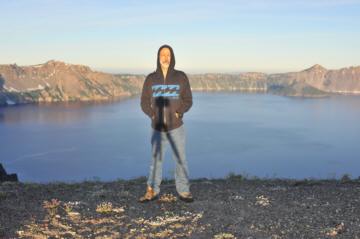
.JPG "Mike at Reflection Lake, Lassen Peak in the background")
.jpg "Lassen Peak from Eagle Peak as sunset begins")
.jpg "Moon rise and last sun light")
.jpg "Moon rise and last sun light")
.jpg "Mike and rising moon after sunset")
.jpg "Busy Lassen Peak trailhead parking lot at moonset")
.jpg "First light on Lassen Peak, moonset")
.jpg "Full moon setting at sunrise")
.jpg "Sunrise on Lassen Peak")
.jpg "Sunrise on Lassen Peak from Devasted Area view point")
.JPG "Helen Lake still frozen in August")
.JPG "We meet at last!")
.JPG "Camp above Lake Mary")
.JPG "Mark and Ora in camp")
.JPG "Mark tries out the shower facilities in camp")
.JPG "A fire is nice when it's chilly and buggy")
.JPG "First-night dinner preparations")
.JPG "Sunset over Lake Mary")
.JPG "A bear visited us the very first night at Lake Mary")
.jpg "Mts Ritter and Banner at sunrise from Minaret Summit")
.JPG "French pressed Peet's coffee")
.JPG "Last night's dinner with fresh corn on the cob")
.JPG "Lana gets Jeff's horse ready")
.JPG "Ben's good to go")
.JPG "Mark is ready to go!")
.JPG "First part of the trail through thick forest. All the trail is DUSTY.")
.JPG "Next part of the trail hugs a steep slope")
.jpg "At lunch, Mark updates facebook")
(small).jpg "Ora's image, lunch break")
(small).jpg "Ora's image, lunch break")
.JPG "Mts Ritter and Banner greet us as we approach 1000 Island Lake")
.JPG "Packers Fred and Louie unpack at camp")
.JPG "Packer-in-charge Fred and his dog")
.JPG "The french press made it intact")
.JPG "Camp, with Banner Peak through the trees")
.JPG "Wine cellar")
.jpg "First sunset over the tarn beside camp")
.jpg "First sunset over the tarn beside camp")
.jpg "First sunset over the tarn beside camp")
.jpg "Stars over camp the first night")
.jpg "First sunrise on Banner Peak over 1000 Island Lake")
.jpg "First sunrise on Banner Peak over a tarn near camp")
(large).jpg "First sunrise on Banner Peak over a tarn near camp")
.JPG "The falls we found off-trail")
.JPG "Ora gets his first fish!")
.JPG "Davis Peak behind Davis Lake")
.JPG "Davis at Davis Lake")
.JPG "Mike near unnamed peak above Davis Lake")
.JPG "1000 Island Lake, High Trail, Minarets")
.jpg "Sunset on Banner Peak over camp and tarn")
.jpg "Milky Way over camp")
.jpg "Sunrise on Banner Peak over 1000 Island Lake")
.JPG "Cross-country hiking, Island Pass and camp in the background")
.JPG "Waterfall dropping draining beneath a snow bank")
.JPG "Starting up almost continuous snowbanks")
.JPG "Starting up almost continuous snowbanks")
.JPG "Ben takes a break beneath Banner Peak")
.JPG "Jeff celebrates reaching the pass")
.JPG "We made it!")
.JPG "Ben surmounts a boulder")
.JPG "Gary and Jeff glissade down a large snowfield")
.JPG "Ben glissades down a large snowfield")
.JPG "Ben plays at a glissade gone bad")
.JPG "Ben on our scenic return route")
.JPG "Gary and Mike on our scenic return route")
.jpg "Banner Peak beyond our little tarn, early afternoon")
.JPG "The packer wrangles our gear onto pack mules")
.JPG "Aaaannnnddd they're off!")
.JPG "Riding off into the sunset...")
.JPG "Wildflowers during our one break, near sunset")
.JPG "Wildflowers during our one break, near sunset")
.JPG "Wildflowers during our one break, near sunset")
.JPG "...and we're off on the final leg as the sun sets")