| Containment of the Sublime
In Hegel's System
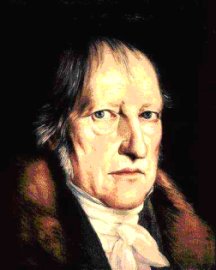
The single most powerful aspect of religion, on which its doctrines are grounded and to which religious minds diligently aspire, is religious experience. However, once this experience is attained, the recipient faces a linguistic dilemma: The power of such an occurrence often transcends the ability of language to adequately convey it. The recipient is prone to feel that the root of their experience lies not in clearly discernable events, but rather in an ineffable totality. Experiences of this nature may be termed "sublime." The nature of the sublime and its relation to language and religion are examined in the works of G.W.F. Hegel. Hegel's view will be presented here and later critiqued with regard to its lack of success in establishing a feasible model of language and the sublime. In his Lectures on the Philosophy of Religion, Hegel defines the sublime as the absolute, infinite manifestation of God (also called Absolute Spirit and Absolute Reason), in the phenomenal world. Through the experience of the sublime, the recipient gains intimate knowledge of God, which in turn his necessary to the existence of God himself: God is God only insofar as he knows himself; his self-knowledge of himself is moreover his self-consciousness in man, it is man's knowledge of God that goes on to become the self-knowledge of man in God. (Taylor 481) Although it may be difficult to conceive of a finite being acting in accord with the infinite, as is intrinsic in the necessarily human contribution to God's self-knowledge, Hegel does not see the pairing of antitheses as indicative of contradiction. This is so because opposing concepts do not exist as purely discrete entities. In fact, they are mutually dependent on one another for their very existence as concepts, possessing a fundamental unity that is only revealed through initial opposition. For example, it is intuitively accepted in everyday language that a concept such as motion is reliant upon its antithesis, stasis, to give it meaning. The initial pairing of contraries is the first stage in the dialectical process that forms the center of Hegel's philosophical system, for it is only through juxtaposition that the underlying unity, or mutual dependence, between concepts may be discovered. By "discovering" the essential unity within antitheses, the individual mind gains knowledge of the absolute, vitally participating in the continual process of God's self-knowing. Thus, in confrontation with the infinite absolute, the finite individual derives from their finitude their deep separation from God; this creates, in turn, a desire to overcome differentiation from the infinite. Only when this desire is present do human beings strive to know God, making the opposition and subsequent integration of antitheses necessary to God's progression through self-knowledge. Because God exists as Absolute Reason, cognitive processes are vital in attaining knowledge of God. Hegel states: Since we know God [who is] absolute reason, and investigate this reason, we cognize it, we behave cognitively. Absolute spirit is knowledge, the determinate knowledge of its own self. Therefore when we occupy ourselves with this object it is immediately the case that we are dealing with and investigating rational cognition. (LPR 96) To summarize Hegel, reason can only be investigated rationally, necessitating a cognitive approach to understanding the absolute, which is reason itself. Language is the means by which rationality, or thought, begins and develops. Hegel draws the connection between reason and language more completely, suggesting: "the acquisition of a language is the acquisition of the capacity for thought" (Inwood 100). Thus, because language and cognition are fundamentally interfused and Absolute Reason must be approached cognitively, language is fundamental to human understanding of the absolute and ultimately to the development of God's self-knowledge. However, finite beings do not gain knowledge of the infinite without preconditions. Religion is imperative for the individual to gain understanding of the absolute. Hegel defines two dimensions of religion: "a representation of God, and a powerful sense of separation from him which the believer longs to overcome" (Taylor 482). Religion allows the individual to take the initial step toward knowing God by perceiving him through representations. In order to feel distinct separation from God, the finite being must first recognize him through representative manifestations. As representations are by definition inherently symbolic, I believe it may be posited that religious language, as it is the primary symbolic means by which God is conceptualized, acts as a fundamental representation of the absolute. By signifying God linguistically and defining him as apart from the subject, the individual exists in immediate separation from God, entering a necessary phase in the continuous process of integration. In my estimation, it is evident from the before mentioned criteria that because language is of central importance to human understanding, the process of integration with the infinite begins with God's representation in religious language. Although Hegel defines language as thought itself (a manifestation of Absolute Reason and thus originally infinite in nature), I suggest that because language exists by means of human expression, it possesses a degree of finitude, retaining antithetical opposition to the infinite it endeavors to signify. It is inherent in Hegel's discussion of Biblical hermeneutics in the Lectures on the Philosophy of Religion that when interpreting examples of finite media, such as religious texts, individual consciousness must transcend the apparent disparity between opposites, ultimately recognizing the infinite nature that lies within each concept (LPR 93). Each individual must then elaborate these concepts, explicating them to the extent that their true quality is understood and ultimately recognizing that these apparent opposites are not disparate, but essentially inseparable. (For instance, finite cannot be conceptually grasped apart from infinite.) Because Hegel equates thought and language, it may be stated that the "elaboration" and "explication" of concepts must be linguistic in nature. Through sufficient development in language, these concepts will become in explicit form what they are implicitly-arriving at themselves, becoming "object to itself," and contributing to the progression of God's self-knowledge. Such is the ongoing, active, and linguistically developing nature of Absolute Spirit. Hegel maintains that representations of the absolute must be actively perceived in order for a human being to know God, and as I suggested earlier, it necessarily follows from this assertion that religious language, as it is the primary means by which God is represented, is fundamental, indeed indispensable, for human knowledge of God to be adequately developed. As was previously established, sublime experience forms the essence of religion. Thus, the use of language in explicating the sublime is for Hegel a fundamental component of sublime experience as such. Because Hegel defines sublimity as the manifestation of Absolute Reason in phenomena, human rationality, or language, is the sole means by which an individual consciousness is able to understand the sublime. This leads to a fundamentally objective conception of religion, for language has little function if it is only exists on a subjective basis. Conclusion As was previously stated, recipients of sublime experience often find language impotent in revealing its basis, for because language is necessarily objectifying, it is only able to fully convey empirical qualities. For instance, an individual may be capable of linguistically indicating properties such as color, texture, shape, and time, yet language remains consistently negligent of deeper sensations present in most, if not all, sublime experiences. As I suggested earlier, a nearly invariable quality of sublimity is the detection of an underlying "ineffable totality." Beyond this designation, however, efforts to objectively contain the experience through language ignore the essence of the experience itself. Because of this fundamental problem, Hegel ultimately fails to provide a satisfactory theory of the sublime, and so of religion.
Catherine Liggett
References Hegel, G.W.F. (1988). Lectures on the philosophy of religion (LPR). Berkeley: University of California. Inwood, M. (2002). Arguments of the Philosophers: Hegel. London: Routledge. Taylor, C. (1999). Hegel. Cambridge: Cambridge University. |