|
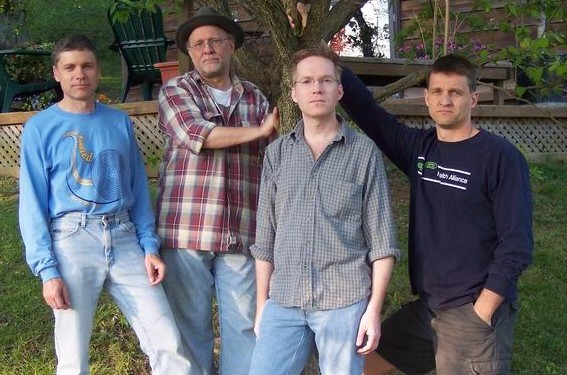
Stace England |
 |
|
|
|
|
Stace England and the Cairo Project: A Snakebit City's History in Music
Southern Illinois is littered with ghost towns. The rivers and railways carried with them
progress, depositing clusters of encampments that grew into thriving villages fed on a steady stream of capital. But soon
highways and interstates redirected traffic, cutting off the flow of commerce to the suddenly far-flung towns until they atrophied
like gangrenous limbs and fell away. For all the towns rendered irrelevant by newly eroded paths of commerce or choked by
mine closures, perhaps no town in Southern Illinois has experienced a decline as steep and dizzying and tragic as Cairo.
Stace England's latest album Greetings from Cairo is an elegant and uncompromising look at
that sad, storied town, from its roots as a major Midwestern hub during the days of Mark Twain to the ascent (and perhaps
simultaneous descent) into a vice economy before exploding with racial tension and subsequently rotting away into a red-state
ghetto. The album traces the history of Cairo through music, opening with the jaunty harmonies of barbershop ditties, blues,
and country before all the disparate genres collide to make funk and soul and rockabilly.
Greetings from Cairo is both a raucous party of a disc and a musical museum. Stace England, its creator and curator, is a soft-spoken troubadour with a bent for history and a jones for melodies of all stripes and types, a singer/songwriter equally comfortable with blues and country and rock and pop. England was a member of House Afire, a Chicago band who played country/roots music half a decade before every other band in the Second City rediscovered Woody Guthrie. He went on to play with Tecumseh and the Jubilee Songbirds, recording albums of "aggressive folk" and alt/slasher-country respectively before going solo and releasing Peach Blossom Special and the power-pop disc Lovey Dovey All the Time. For the last five years, England has been at work researching and writing Greetings from Cairo,
an album born of his minor obsession with the declining river town.
"The big catalyst to move forward was a book by SIU Press, Let My People Go by Jan Roddy and
Preston Ewing," England explains. "[They] took hundreds of photographs of all the stuff going on. I was blown away by that
book. One of the things about Cairo is that it's like a parallel universe, a southern town in a northern state. None of it
makes any sense-- but it all happened."
England describes the town's history as "snakebit," seemingly cursed. It's that very history,
dark and inexplicable, filled with gallows humor (and sometimes just gallows) that inspires him, so much so that one of his
greatest tasks in making the CD was editing the tunes and the material to fit onto a single CD.
"I could have written a hundred songs about that place. It's this cross-section of northern
and southern culture and history and transportation. It all converges. It's a big stew of everything," England says, noting
that Cairo is either a romantic town felled by tragedy or a tragic town full of strange, secret romance. "It's more tragedy
right now, but there is that romantic notion, what could have been, what should have been. The reality unfolding on the ground
right now is that of tragedy, with all the poverty and urban decay and infighting. The mayor and the city council constantly
fight and sue each other. They're in this self-perpetuating cycle. But there are many people who love the town and who want
to get some stabilization, save some old buildings. There's no way it's going to make a comeback, but there could be a stabilization
if people ever got their act together. It's not going to be what it was in the thirties but it could be an important historic
site."
The album opens with the only two songs on the disc not written by England, "Goin' Down to
Cairo" and "Cairo Blues." The first track, sung by the Little Egypt Barbershop Chorus, opens the record with a nostalgic twist,
echoing the long-gone wellspring of optimism. "Goin' Down to Cairo" sets the tone of the CD by way of antithesis, injecting
a hopeful note overhung with dread and melancholy, the harmony heavy with the weight of the chaos to come.
The remaining nine tracks are written by England and performed alongside some of Southern
Illinois's most notable musicians. Departing guitar guru Jimmy Salatino lends a hand, as do Makanda favorites the Woodbox
Gang and Carbondale's expatriate legend Jason Ringenberg.
England says he wrote most of the songs with the collaborators in mind, noting, "I had a sense
of kind of the players I wanted on specific tracks, like the Rum Runners' horns on 'Jesse's Comin' to Town.' Everybody was
willing to do it. These people are great musicians, but they're also great human beings."
Personal greatness aside, England's consciousness of the collaboration during the writing
stage allows the talented group of Carbondale pickers and singers to shine. While the album is a jumble of styles and genres
centered around a concept, each track has clarity and autonomy, a focus. On "Equal Opportunity Lynch Mob," a song about a
black man and a white man strung up by a bloodthirsty rabble on the same night, England isn't just backed by the Woodbox Gang.
Instead the song sounds like a Woodbox Gang song with its black comedy and subtly unsettling source material:
We're an equal opportunity lunch mob
Vengeance with an open mind We marched to God's drumming When they had it coming Justice should be colorblind Perhaps England's most esteemed cohort is Jason Ringenberg, the SIU alum and coinventor of cowpunk who hit Rolling Stone's one-hundred greatest albums of all time along with his bandmates the Scorchers. England says he wrote "Prosperity Train" hoping to find somebody "who could really nail it, somebody like the Scorchers," then decided to take the track to the man himself. "I had a little bit of contact with [Ringenberg] a number of years ago," England explains.
Just as Ringenberg was putting the finishing touches on his latest record Empire Builders, England sent him the song. "He
said 'I like it, I'm way into it, and if we do it right now I've got people in the room already.' The timing was cosmic to
make it happen, and we were able to bang it out pretty quickly. He liked the idea of a Cairo CD and he liked the track. I
think he nailed it to the wall."
England cites Ringenberg's contribution-- perhaps the most balls-out, honkytonk rock song
on the record, along with the excellent "White Hats"-- as his favorite. He says that it's particularly hard with this album
to pick favorite songs, however, "mainly because of the performances that the bands brought to them. I love 'Equal Opportunity
Lynch Mob' because of what the Woodbox Gang did on it. I'm so delighted. To me it feels more like collective project than
a solo record."
The multitude of contributors (fifty-six, if you're counting) and England's write-for-the-collaborator
approach keeps Greetings from Cairo from suffering from the standard maladies of the concept album. In other words, England's
latest is no Tommy or Kilroy Was Here. Each song-- with the likely exception of "Goin' Down to Cairo" which mostly works as
an intro track-- works well standing alone. England has written a group of songs that are fully independent, occasionally
disparate, which are more associated than linked. Greetings from Cairo, then, is more akin to a mosaic than a narrative. The
album is a kind of "Magic Eye" CD that is intriguing when scrutinized piece by piece but which unfolds as a much more compelling
and complex picture when viewed as a whole.
"I like the challenge of a concept album," says England. "If you're going to string things
together, that's an even higher bar to shoot for. It's just an issue of trying to maintain focus, selecting the best nuggets
from the landscape of what your concept is. That's the challenge is editing things... then latching onto them and stringing
them together in a way that makes sense to people. Can this be done? Can we pull it off? It could be ridiculous or sublime."
Sublime seems to be the overall opinion. Even across the Atlantic, Greetings from Cairo is
a hit.
"We're getting some nibbles in Europe," says England. "We didn't know if the story would resonate
with people outside of the region, and we're finding that it does, which is great. We've gotten some Italian and British reviews,
which are quite good."
Being well-received by music critics is one thing, but having the work welcomed by those who
live and work and die in Cairo might be entirely different. England says he has not yet talked to the townsfolk, many of whom
he worked with during his research, to discover their perspective on the record. England is optimistic about the reception
his latest work will receive from those who will find the songs the most immediate and personal, although he remains realistic
about the likely opinions regarding some of the album's gritty, unflinching, and at times downright unpleasant content. The
song "White Hats," for instance, tells the story of a radical kind of neighborhood-watch group that took a turn for the surreal.
Soon the group of not-quite-vigilantes became hundreds strong and began wearing white construction hats to show their membership
in a group whose crimes were not limited to fashion faux pas but racism, paranoia, and bullying. (England writes in the upbeat
but foreboding song, "White hats, minds full of hate/Equality is gonna have to wait.")
"A lot of people won't like some of the content like "White Hats," because a lot of those
people are still living. When I first started doing research I showed up and said I wanted to make a record and everybody
kind of clammed up. There's kind of a persecution complex toward outsiders: 'Why are you doing this?'"
England insists that he has a lot of love for the town. He says he's not trying to criticize
or point fingers, but the ugly side of Cairo's history is just as real (and perhaps more immediate) than its pleasant side.
"The analogy I use is, when you talk about U.S. history, you can't not talk about slavery
or Japanese internment in World War II," he says. "You have to be upfront about it. You can't talk about Cairo without addressing
the race question. You try to see both sides of the coin. On 'White Hats,' for instance.... I've always viewed those guys
as very cartoonish, guys running around armed with white construction hats. It helped me understand the mindset of how that
happened, because in these people's minds, society was coming apart. These riots are breaking out and people don't know what
to do, but then [their intentions] unfold into something more sinister. That group may have started with the best of intentions,
but... well, I've tried to approach and learn by talking with both sides in that. There are a lot of good people in that town
who got caught up in wild stuff, people on both sides, but that doesn't mean they're bad people."
The negative, England says, is not his focus. He's content to live in Carbondale, sing about
Cairo, and keep getting by with a little help from his friends.
"It's a pleasure to make music here, and I am in great debt to everyone who worked on the
record," he says. "Now we're trying to bring Cairo to the world."
- Bryan Miller |
|