A Quest for Our Cosmic Origins
The First Three Days
Copyright © 2010 Edwin L. Kerr
Summary of the rest of “The First Three Days”
Creationism that
Scientists Can Accept
Chapter 1–Moses Foresaw Three Discoveries
The
Three Discoveries
Space exploration has opened a new quest for the cosmic origins of life on Earth. From outer space we find a new perspective on old questions. Scientists gathering data with satellites and astronomers peering through giant telescopes have combined forces with nuclear physicists to produce many theories about the creation of the universe.
The scientific basis of these theories consists mainly of three discoveries from the last hundred years or so. Theories will continue to change and develop, but the three discoveries we identify here have been confirmed in many ways. The three discoveries form a tripod, a stable foundation for cosmology[1]. Cosmologists expect that further discoveries will only refine, not refute, the three discoveries we will examine here.
The three discoveries are not ideas that emerge through philosophical reasoning. If they were, they would not have remained undiscovered until the twentieth century. Even careful, patient, thoughtful observers cannot see the evidence for the three discoveries without modern instruments.
The three discoveries have shaped current views of the origin of the cosmos. They also unexpectedly confirm ancient ideas found in the Bible. This can resolve an old controversy over differing definitions of the universe.
To get started, by the end of this chapter we will have explained the discoveries well enough to show how remarkably they confirm the Bible. In subsequent chapters we will delve into the discoveries in greater detail. Delving will lead to additional confirmation.
The
First Discovery
The first discovery was a step toward answering the age-old question: How did all that we see appear?
A sheet of paper was originally part of a tree. Trees come from seeds, soil, water, air and sunlight. Soil is a mixture of small grains of sand and organic matter. The organic matter and seeds came from previous trees. Which came first, the acorn or the oak? What is the origin of minerals, water, and air? Also, where does the sunlight fit in?
There are various ways of transforming one kind of material into another. In the 18th and 19th centuries chemists began to keep careful track of the weight of materials that enter and leave a reaction. They proved that the total input weight is always equal to the total output weight. From this they concluded that material or matter is neither created nor destroyed, but only transformed from one kind to another, in any chemical reaction. “Matter is conserved,” they said. But what is the origin of matter?
Heat dissipates some of the mechanical energy of drilling, and makes a ball stop bouncing. James Prescott Joule (English physicist, 1818—1889) did many experiments that established the equivalence between heat and mechanical work. One watt-second is one joule, an energy unit named in his honor. Recognizing heat as a form of energy completed the balance sheet for many kinds of energy transformations. Physicists and engineers also had a conservation law. “Energy can’t be created or destroyed,” they said, but they didn’t say where energy comes from.
The two laws came together on the subject of combustion. Fire is a chemical reaction that produces heat and light. Observation without instruments easily leads to the idea that fire destroys material and changes it into energy. Firewood is heavy. Ashes weigh much less than firewood but they still fall to the bottom of the fire pit as the flames shoot upwards. However, chemists using delicate balances showed that fire does not change the total mass of material. They trapped and weighed the gases that enter and come from the burning. The weight of the firewood and the oxygen consumed is equal to the weight of the ashes and the smoke, but what about the energy? Doesn’t it weigh anything? Is firelight just the sunlight the leaves absorbed and the wood stored somehow?
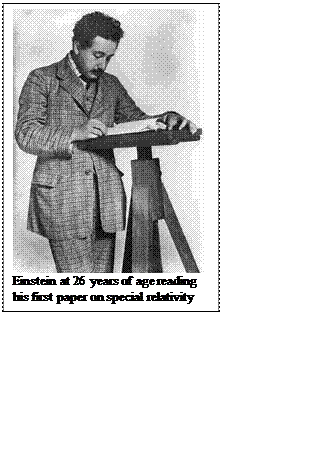 The Mass and Weight of Energy
Albert
There is heat and light latent in firewood. It is in the energy that holds the carbon and hydrogen atoms in the firewood together. These atoms combine in chemical substances called carbohydrates because of electromagnetic forces between their outermost electrons. Carbohydrates are large, complex, organic molecules that form dense substances. As the wood burns the carbohydrates break up. The carbon and hydrogen combine with oxygen from the air to make carbon dioxide and water vapor. These products are gases with small, simple, inorganic molecules. Together with small particles of soot (unburned carbon) they go up the chimney as smoke. Combustion releases the chemical energy that held the carbohydrates together. This energy leaves the fireplace as heat and light.
To measure the weight of the heat and light, chemists need balances with a precision of nine or ten significant figures. Nobody can yet weigh anything that precisely. We need to improve balances by a factor of 1 000 or 10 000 or more before we can weigh matter and light from chemical reactions at the same time.
Separately,
of course, we can weigh material or energy.
We weigh them by measuring their tendency to fall toward an attracting,
gravitating body like the Earth or Sun.
Chemical balances compare precisely the gravitational attraction of the
Earth for an unknown quantity of material in one balance pan with its
attraction for standard weights in the other balance pan. We can’t weigh light the same way. However,
Atoms store
chemical energy in the electromagnetic forces between their positively charged
nuclei and their shells of negatively charged electrons. There is much greater energy in the nuclear
forces within the nuclei of atoms. When
large nuclei break up into smaller ones some of this energy is released in the
kind of nuclear burning we call fission.
Transformation
between Matter and Energy
If material
and energy both have mass and weight, are they really different forms of one
substance, and can one be transformed into the other? Some philosophers before
The most important upshot of the special theory of relativity concerned the inert masses of corporeal systems. It turned out that the inertia of a system necessarily depends on its energy-content, and this led straight to the notion that inert mass is simply latent energy. The principle of the conservation of mass lost its independence and became fused with that of the conservation of energy.[2]
Materialization
To work in units people know, we need
A watt-second is the energy required to keep
a one-watt lamp lighted for one second.
Usually a power utility bills us for electricity in kilowatt-hours. A kilowatt-hour is 1000 watts times 60
minutes per hour times 60 seconds per minute.
That multiplies out to 3.6 million watt-seconds, the amount of energy
needed to keep ten lamps of 100 watts each lighted for an hour. It takes 25 000 million kilowatt-hours
of energy to produce one kilogram of material.
Different
Kinds of Rays
Material is composed of subatomic particles
like neutrons, protons, and electrons, listed in order from highest to lowest
weight. Electromagnetic rays are the
tracks of energy particles called photons.
The weight and the energy of a photon are directly proportional to the
rapidity of vibration of the rays. If we
want to make particles from photons, we must use photons with an equivalent
mass at least as great as the mass of the particles we want to produce. Since c² is a large number, we need
very energetic photons to make even low-mass particles.
X-rays have the most energetic photons scientists can produce with laboratory
equipment. Low-energy gamma rays are identical to X-rays, but we use the term “gamma
rays” to refer to energetic rays from natural sources. Some gamma rays have photons that are much
more energetic than the most energetic X-ray photons we can produce.
Light rays are visible and make other things visible. All other rays are invisible, dark to our eyes. When doctors make an X-ray picture, they send a powerful pulse of energy through the patient’s body. The X-rays expose the film, but the patient sees nothing. To the patient X-rays are dark.
An electron has the lowest mass of the three most common subatomic particles. Nevertheless, its mass is equivalent to the energy of the hard X-ray photons we use for treating cancer, much more than the energy of the softer X-ray photons we use for medical diagnosis. Visible light photons are far too weak to make electrons, let alone protons or neutrons.
No
Way Rich
Physicists have the capability of making gold
directly from energy. When a cyclotron’s
dark rays collide they
materialize as
electrons, protons, and neutrons.
Nuclear reactions can put protons and neutrons together to make nuclei, and when the nuclei are cool enough they
will attract the electrons to make atoms. Gold
atoms have 79 electrons, 79 protons, and 118 neutrons to help hold the protons
together in the nucleus. Probably no one
has ever carried out the complete process of constructing a gold atom from
particles. Certainly no one can get rich
making gold directly from energy. A
recent market price check showed that the electrical energy the cyclotron
converts into particles costs 1000 times more than the value of the gold.
This emphasizes that it takes huge amounts of energy to make a tiny bit of matter. But a powerful agency can do the job. Matter is neither indestructible nor eternal. It can materialize from energy. We have seen why neither heat nor light nor ultraviolet rays nor soft X-rays can materialize. To materialize, rays must be at least as energetic as the hard X-rays physicists make with cyclotrons or linear accelerators.
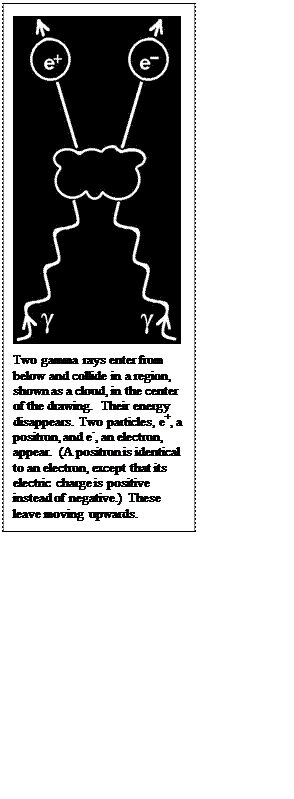 Materialization in “Empty”
Space
Materialization in “Empty”
Space
Since we can see the stars, we know that light can travel in space. We say that space is empty when it contains no matter, but empty space always contains the energy of heat and of any light in transit. We have never been able to make any space so cold and dark that it has no energy at all. Electromagnetic rays are a kind of energy that can exist in empty space.
A single ray cannot materialize all by itself. Two rays, or a ray and a particle, must collide to materialize. If there is a particle present then the space is not empty, so let us talk first about the collision of two rays. When gamma rays or hard X-rays collide, they convert some or all of their energy into particles. The particles may be components of atoms, such as protons, neutrons, and electrons, or other, less well-known particles. We cannot see atoms because atoms are 5 000 times smaller than light waves. Subatomic particles are even smaller. During the collision, some of the original energy may become kinetic energy, the energy of moving objects. If so, the particles will depart from the scene of their materialization at high speed. If any of the original energy remains, it will travel on as one or more photons of lower energy. The photons continue to collide and fracture until they lack enough energy to materialize.
Dark rays become visible when they collide, fracture, and partially materialize as particles. The particles must form atoms, and the atoms must combine in great numbers before there is visible material. The remaining energy may be soft X-rays, ultraviolet rays, light, or heat. Only the light rays are visible.
Was
Energy the Source of Material?
It is easier to describe the picture of how things were soon after the beginning. We must imagine the picture. We cannot see it, because there was no light at the beginning. The beginning was perfectly dark.
Very soon after the beginning highly energetic rays were spreading throughout space and traveling in all directions. When the rays collided they collided everywhere, and often partially materialized as particles. The universe was suddenly filled with an energetic mixture of rays and particles. Some of the rays lost so much energy when partially materializing that they became light rays. Suddenly the picture filled with light. The source of the light was the energetic darkness of gamma rays. Since the darkness had been everywhere, the light shone out of everywhere, starting from all points and spreading from them in all directions.
Other rays, those that retained even less energy than light rays, became heat. All the rays and particles collided frenetically with one another. The mixture had an extremely high temperature and pressure. The pressure made the mixture expand and cool. After a very short time, when the mixture was cool enough, some of the protons and neutrons stuck together and formed simple nuclei of just a few particles each. Cooling stopped the formation of nuclei after the first three or four minutes. Some 380 000 years later the mixture was cool enough to let the nuclei capture the free electrons and become atoms. This was the beginning of matter as we know it.
Any nucleus can
form an atom if it
cools enough to capture a number of electrons equal to its number of protons. The
electrons are too lightweight and active to stay in the nucleus. They form a cloud around the nucleus about a
thousandth of a micrometer in diameter.
The nucleus is about ten thousand times smaller than that. Atoms subjected to intense heat or bombarded
with ultraviolet rays or
high-energy electrons turn back into plasma, a mixture of bare nuclei and
electrons. Flames and the gas in neon
signs are examples.
At the
beginning heat and pressure started the universe expanding.
This movement must have started at some time in the past. If it had always been going on, forever and ever in the past, then by now all the other galaxies would be infinitely far from us, and we wouldn’t be able see any. But the sky is full of galaxies. Therefore we know that at a certain moment, not infinitely remote in the past, all the material and energy of the universe was close together in a fiery mixture. This moment marks the beginning of the universe. The best information we have now says that the beginning was 13 700 million years ago.
The pressure that drove the expansion came from the heat and light of the original fiery mixture. Heat and light produce a pressure called radiation pressure. The newly materialized particles also moved in all directions at various speeds. When this kind of movement is entirely due to heat and completely random we call it thermal agitation. Its characteristics are well known from theoretical analysis and experimental confirmation. Temperature determines most of its characteristics.
People are familiar with relative temperature, measured above or below the freezing point of water on the centigrade or Celsius scale, or above or below the temperature of a well-drained salt-and-ice mixture on the Fahrenheit scale. Scientists measure absolute temperature from the lowest possible temperature, a temperature so low that thermal agitation ceases and particles are frozen together. The lowest possible temperature is called “absolute zero.” On the more familiar scales it is ‑273.15 ºC or ‑459.67 ºF.
Scientists no longer use the word “degrees” when quoting an absolute temperature. The unit of absolute temperature is the kelvin, after William Thomson Kelvin (British mathematician and physicist, 1824—1907). The kelvin is a unit of temperature just as the meter is a unit of distance and the second is a unit of time. We do not say “degrees meter” or “degrees second.” On the absolute temperature scale water freezes at +273.15 kelvins (0 ºC, 32 ºF) and boils at +373.15 kelvins (100 ºC, 212 ºF). Kelvins and Centigrade degrees represent the same increment of temperature, but a Fahrenheit degree is 5/9ths of that increment.
The pressure of thermal agitation depends on the temperature, but it is not entirely steady. A random bombardment of particles produces thermal agitation pressure. Since the bombardment is random, the pressure has small fluctuations. Robert Brown (British botanist, 1773—1858) used a microscope to observe small particles suspended in a liquid. He discovered that they move erratically. In 1905 Einstein explained that the erratic motion arises because random thermal agitation of the molecules of the liquid makes pressure fluctuations. The net pressure is slightly higher first on one side of a small particle, then on another. Experimentalists subsequently confirmed Einstein’s explanation.
Fluctuations are therefore the visible result of thermal agitation. If the original fiery mixture of the universe had been perfectly uniform, without any fluctuations, we would be wrong to expect it to show the other thermal characteristics it has. The light from the fiery mixture is the most perfectly thermal light scientists have ever analyzed.
Since the mixture was hot and thermal, physicists can apply to it everything they know from studying similar mixtures in the laboratory. This warrants their theoretical analyses, and builds confidence that we really understand what we are seeing.
The present universe could not have formed from a perfectly uniform initial state. There can be no net gravitational attraction if all the material and energy is evenly distributed over all points of space. Gravitational force is directly proportional to the mass of material and the equivalent mass of the energy at a given point. If the total mass of material and energy is the same at every point, then the gravitational attraction from any point exactly counterbalances the attraction from all other points. If two teams playing a tug-of-war are equally strong there can be no movement provided the rope is stronger than the teams.
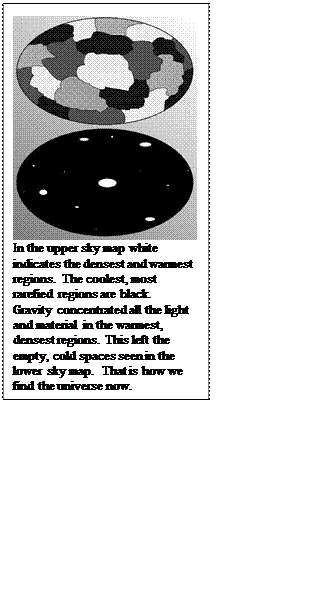 Fluctuations, however, let some
regions pull harder than others. The
regions that pulled hardest were the densest regions, those with the most
material and energy packed into them.
They attracted material and energy out of the more rarified regions. The movement of attracted material and energy
left the dense regions denser and the rarified regions more rarified. This made the fluctuations more pronounced. It also made the dense regions more strongly
attracting. The gravity of the dense
regions compressed them and heated them up again. It also swept space bare and made the
rarified regions more rarefied.
Eventually the rarified regions joined together to become a dark, cold
void punctuated here and there with dense clouds of bright, hot gas. The original dense fluctuations served as
seeds of condensation or centers of attraction.
The dense clouds became galaxies containing stars and planets. The universe took on the aspect we see now in
the night sky: isolated points of light
and heat in a dark void.
Fluctuations, however, let some
regions pull harder than others. The
regions that pulled hardest were the densest regions, those with the most
material and energy packed into them.
They attracted material and energy out of the more rarified regions. The movement of attracted material and energy
left the dense regions denser and the rarified regions more rarified. This made the fluctuations more pronounced. It also made the dense regions more strongly
attracting. The gravity of the dense
regions compressed them and heated them up again. It also swept space bare and made the
rarified regions more rarefied.
Eventually the rarified regions joined together to become a dark, cold
void punctuated here and there with dense clouds of bright, hot gas. The original dense fluctuations served as
seeds of condensation or centers of attraction.
The dense clouds became galaxies containing stars and planets. The universe took on the aspect we see now in
the night sky: isolated points of light
and heat in a dark void.
Einstein’s and Hubble’s discoveries, the materialization of energy and the expansion of the universe, combined with what we now know of nuclear and atomic physics, lead to a working model of the beginnings of the universe. First, something happened in the darkness. A fraction of a second after the beginning there was a fiery mixture of particles and rays, expanding under tremendous pressure. Eventually, the average temperature of space dropped to less than 3 kelvins and the galaxies formed.
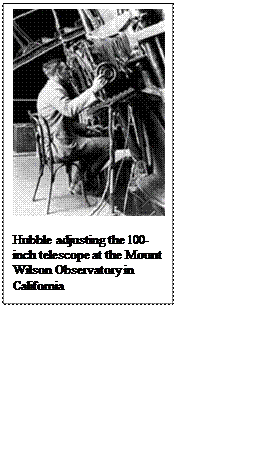
Hubble was working with the largest telescope of his day when he made his discovery. Even so he could not see very far into space. This meant that he could only observe conditions in the relatively recent past. Light moves very fast, but still takes years to arrive even from the closest stars. We can never see how things are at the present moment in the heavens. What we see there is now past. The farther out one looks into space, the farther back in time one sees.
Telescopes gradually increased in size and performance. Nevertheless, they could not see very close to the beginning. Therefore theories had to rely on indirect evidence for confirmation. By 1948 Ralph Asher Alpher (American physicist, 1921—), Robert Herman (American physicist and civil engineer, 1914—), and George Gamow (Russian-born American theoretical physicist, 1904—1968) had calculated that the original high temperature of the universe has dropped to about 5 kelvins at present in the coldest empty regions of space. (We now know the temperature more accurately. It is 2.735 kelvins.)
This temperature is too cold to produce visible light. Bright red coals or electrical heating elements have a temperature of 850 ºC to 950 ºC (1 562 ºF to 1 742 ºF). Some people can see incipient red heat beginning at temperatures as low as 500 ºC (932 ºF). Five kelvins is ‑268 ºC (‑450.4 ºF). Therefore no optical telescope could ever see the first light, no matter how far it could look. We need a radio telescope to detect the electromagnetic waves that correspond to so low a temperature.
 The Third Discovery
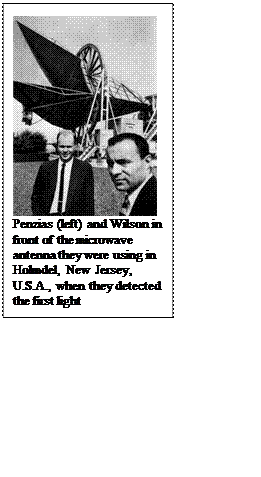
In 1964
Arno Allan
Penzias (American radio astronomer, 1933—) and Robert Woodrow Wilson (American radio astronomer, 1936—) of
Bell Labs were trying to improve the quality of microwave links for telephone
communications. They wanted to reduce
interference coming from the land and sky. Penzias and Wilson were not looking for the
first light, but the microwave antenna they were using detected it coming from
the fiery mixture soon after the beginning of the universe.
Many people
ask how we can still detect the first light after 13 700 million
years. Let’s remember that the universe
is very large. In the beginning light
burst from every part of the universe, because the
gamma rays collided everywhere.
See the drawing for an explanation.
Anyone can detect the first light with equipment as commonplace as a television set. Just turn it on and select a channel with no clear picture from any nearby television station. The picture will be a dance of black and white dots. (Some newer television sets recognize the lack of a strong signal and blank their screens. To see the dance of dots, use an older television set.)
According
to the measurements Penzias and Wilson made, seventy percent of those dots are
electronic noise from man-made artifacts.
The noise comes from TV stations too far away for clear reception,
electric motors, and other man-made apparatus.
Most of the rest of the dots are random emissions from the Sun, other
stars, and distant galaxies. But one dot
in a hundred comes from the original light of the early universe. The original light, now cooled down to radio
waves, strikes the TV antenna after traveling from the edge of the visible
universe. The light comes from regions
whose distance in light years from the Earth is equal to the number of years
since the beginning.
Once I understood the dance of dots, it became my favorite television program!
 The First Light
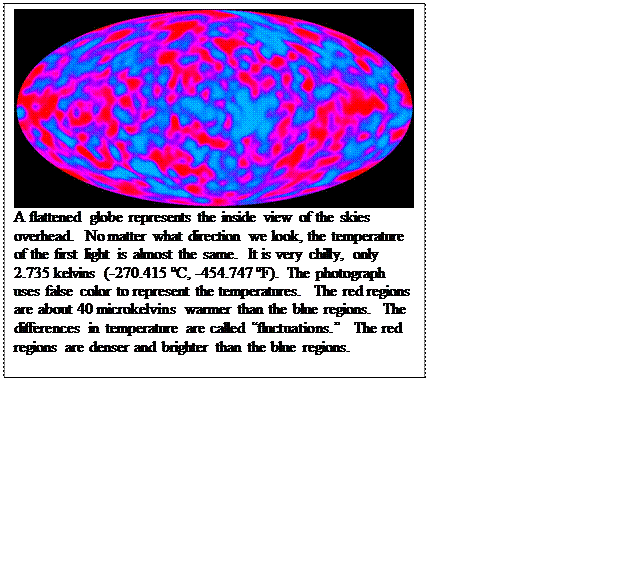
A television set doesn’t give a clear picture of the beginning of the universe. The interference is 100 times stronger than the original light. Researchers have by now studied the first light with antennas even larger than the one Penzias and Wilson used. The Earth’s atmosphere absorbs a large part of the signal. To see better, experimenters worked with mountain-top and balloon-borne antennas. In 1989 NASA launched the Cosmic Background Explorer (COBE). In outer space this satellite was far from man-made interference on Earth. It was also outside the atmosphere. From there the instruments studied the electromagnetic waves that Penzias and Wilson called the “background.” When the waves started out, they were ordinary light, perhaps a little more reddish than sunlight. For this reason, the experimenters may present their data as a “photograph.”
More recently the Wilkinson Microwave Anisotropy Probe has “photographed” the first light with higher resolution and confirmed the COBE satellite picture. We will discuss the more recent observations later, and explain their importance to the study of origins.
Separating
Light from Darkness
Our kind of life depends on complex arrangements of atoms. Atoms cannot stick together at temperatures of millions, or even thousands, of degrees. But the early universe was a fiery mixture of rays and particles, nearly uniform throughout, at elevated temperature and pressure. Expansion under pressure brought down the temperature.
If the temperature, pressure, and density were always perfectly uniform, there would never have been a habitable place in the universe. Life’s habitat must have moderate temperatures, those that make water liquid, neither frozen as ice nor boiled into steam. But, as we will see when we analyze the thermodynamics of life, a much hotter source must supply life with light as well as heat. A perfectly uniform universe cannot have both a star like the Sun and a planet with moderate temperatures like the Earth.
Happily for us, the universe was not perfectly uniform. There were fluctuations of temperature, pressure, and density. These fluctuations had to exist if the fiery mixture was to separate into concentrated regions, some hot enough to supply light and others with moderate temperatures.
Early
Ideas about the Beginning
An empty, formless darkness full of energy collided with itself, partially materialized, and continued in a mixture of rays and particles. Fluctuations created dense, hot regions that served as seeds for separating the material into galaxies, stars, and planets isolated in the vast void of cold, dark, empty space. Are we human beings living at the present time the first to contemplate the beginning of the universe in its true aspects? Or did any ancient people have the same vision?
 Ancient Myths and Modern Cosmology
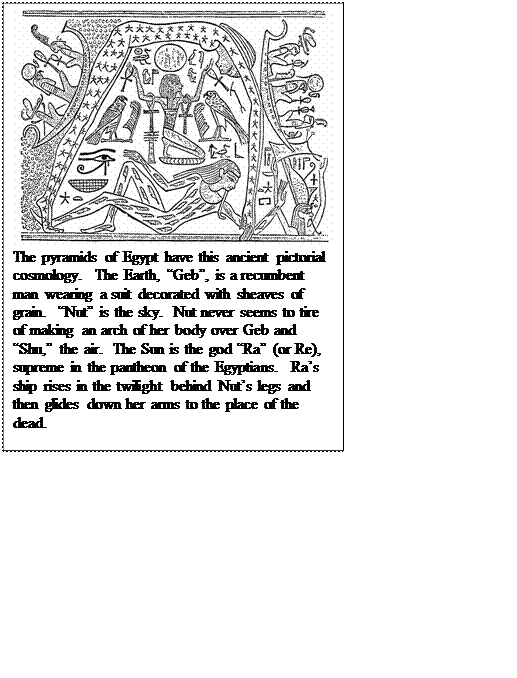
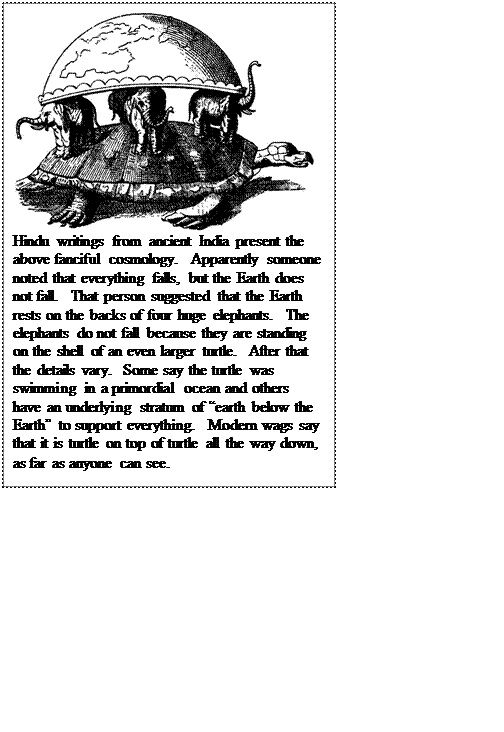
Many ancient peoples projected their own image large on the heavens to explain natural processes. The Sun rode in a chariot through the skies. The god who drove the Sun’s horses usually was reliable, but sometimes eclipses occurred when a reckless driver took the reins. Or there was a Prime Mover who pushed the outermost sphere of the stars. His efforts, transmitted through a system of gears or rollers, also drove the inner, transparent spheres that carried the Sun, Moon, and planets.
Every mysterious phenomenon had a god or goddess in charge. Motherly goddesses made women, livestock, and soil fertile. There were surly, touchy gods that would shoot off volcanoes or send plagues if people failed to appease them with sacrifices. Frequently people suffered merely because the gods were squabbling among themselves. The chief god, instead of keeping order, might spy a beautiful woman and take on some earthly form to go after her, provoking his consort goddess to jealousy and harmful revenge.
Ancient peoples had various insights into the workings of the universe. The question about why the Earth does not fall has engaged great minds for centuries. Even Einstein worked on an extension of the problem. We will see that he studied why the skies do not fall, that is, why the galaxies have not come together in one great clump. It is worthwhile reviewing the ancient cosmologies just to make sure our modern account addresses the questions people have always wanted to know.
At the same time we should be aware of the deficiencies. Almost all the ancient cosmologies suffered from the same problem. The gods, goddesses, and mythical giant animals needed a super universe in which to live. “Nut,” the Egyptian goddess of the heavens, “Geb” the Earth, and the Hindus’ giant turtle all rested on some foundation beneath the Earth. The chief of the gods needed a consort to keep him from being lonely and perhaps eccentric. Who or what provided the super universe, the foundation beneath the Earth, and the gods or goddesses or other superior beings that lived and formed the universe we know? Was there one supreme god, uncreated, pre-existing, without needs of his own, the one who made everything else?
One
Up-to-Date Ancient Cosmology
There is one ancient cosmology that resolves the problems inherent in other ancient cosmologies. Surprisingly, this ancient cosmology refers to the three discoveries. It is completely consistent with the confirmed results of precise science. Let’s examine this remarkable cosmology. It appears in modern translation below.
The First Book of Moses
Genesis 1:1‑8
1 In the beginning God created the heavens and the earth.
2 Now the earth was formless and empty, darkness was
over the surface of the deep, and the Spirit of God was hovering over the waters.
3 And God said, “Let there be light,” and there was
light.
4 God saw that the light was good, and he separated
the light from the darkness.
5 God called the light “day,” and the darkness he
called “night.” And there was evening, and
there was morning—the first day [the correct translation is one day
or a day].
6 And God said, “Let there be an expanse between the waters to separate water from
water.”
7 So God made the expanse and separated the water under the expanse from
the water above it. And it was so.
8 God called the expanse “sky.” And there was evening, and there was morning—the second day.[4][5]
This cosmology is the creation narrative, found on the first page of the Bible, the beginning of the book of Genesis.[6] God creates the heavens and the Earth at first as an empty, formless darkness. The first visible part of the creation, light, appears as a result of making the material, just as Einstein said was possible. Penzias and Wilson detected the first light, and many astrophysicists since have photographed it. In verses six through eight, Moses says five times that God put expansion in the heavens. Moses mentions the expansion after the first light. It had to affect the first light. Stretching the heavens stretches out the waves of light. This had a reddening effect on the galaxies that Hubble observed. From the effect Hubble deduced that the universe is expanding.
The Biblical cosmology is the only ancient cosmology we
know that agrees with these details exactly.
All of the three discoveries are
counterintuitive, especially the idea of the expanding universe. It is so strange that even the Biblical
references to it had other explanations[7] before Hubble’s discovery showed that the expansion is
literal. The literal translation of the
Hebrew word for expansion brings out some other accurate details in the
Biblical creation narrative. Once the
dense regions became compact, they had strong gravity that defined the
directions “up” and “down.” Gravity separated the waters below, in the region
where the Earth would later form, from
the waters above, those in all the other compact regions.[8]
According to the narrative, God caused the expansion. In the Bible God is the ultimate cause, but
He uses immediate physical causes. The
heat and pressure of the first morning were the immediate cause that put
expansion into the heavens.
The first five books of the Bible are called the books of Moses, after the person who appears in the story beginning in Exodus, the second book. Critics may question whether Moses really existed. Their doubts do not affect the above analysis. We know very well that someone who lived before the 20th century wrote the creation narrative. Even if some doubt the identity of the narrative’s author, the narrative is certainly ancient. Clear references to it appear in the Isaiah scroll, found in a cave in Qumran near the Dead Sea. This scroll is 2 000 years old, according to several converging lines of evidence. The evidence includes knowledge of the historical setting in which the scroll was copied, paleographic analysis or dating by the handwriting style of the time, and radiocarbon dating of the scroll’s linen wrapper. The scroll ensures that the Genesis creation narrative is more ancient still.
The creation narrative certainly had one and only one author. The idea that an editor pieced it together from old traditions, or that a committee wrote it, is preposterous. No committee ever wrote anything this good. Novelist and playwright Herman Wouk[9] says that the books of Moses are clearly the work of a genius. Geniuses seldom collaborate because there are few geniuses living at any given time, and it has always been hard for them to get together. However, one creative genius recognizes the work of another. This is a good reason for believing Herman Wouk rather than the critics. Though the critics may grumble, for the sake of clarity and simplicity we will continue to refer to the author of the creation narrative as Moses.
Commentators frequently say that the great religious contribution of Moses was monotheism. He wrote of the one and only God. According to Moses, God is supreme and has no need of anything. He is Himself uncreated and eternal, and He needs no place to live. He alone created all other things. Moses did not get his ideas from the peoples around him. He was probably familiar with the pictorial cosmology found in the Egyptian tombs, but he incorporated none of its ideas in his cosmology.
Many people have noted the parallels between modern cosmology and what Genesis says explicitly. Moses interweaves correctly the three great cosmological discoveries of the 20th century into the first eight verses of his narrative. He gives a coherent account of the development of the early universe. This account was demonstrably written thousands of years before the 20th century.
The
Confirmation
We have analyzed three discoveries, those of Einstein, Hubble, and Penzias and Wilson. The darkness of colliding gamma rays can form matter and light, there is expansion in the heavens, and we have photographs of the first light in the universe. The agreement between the scientific discoveries and the ancient Bible narrative is exact. Correctly anticipating three out of three major scientific discoveries by chance is very improbable.
A
Challenging Question
The
agreement is also unexpected. Bible scholars immediately pose a challenging
question. The author of the creation
narrative lived thousands of years ago, long before there were cyclotrons and telescopes and satellites. How
could the creation narrative incorporate correctly all the fundamental
discoveries of
modern cosmology?
The probability of “just happening to be right” is very small. Ancient writers, like modern writers, usually wrote about things their readers understood and could accept. The Genesis narrative says light appeared on the first day, but does not mention the Sun until the fourth day. For centuries people criticized the narrative for that. Now we know that the first light appeared long before the Sun formed. The first light is 13 700 million years old. The Sun, like the Earth, is about 4 650 million years old. Because of precise science, we now know that the narrative rightly puts the first light before the Sun.
Moses Identifies His Source
Let’s entertain the possibility that Moses, the person who appears in the story beginning in Exodus, is really the author of the first five books of the Bible. We will allow Moses to speak for himself. Where does Moses say he got his information?
Moses explains (Exodus 33:11) and God confirms (Numbers 12:7‑8) that Moses talked with God face to face, as a man talks with his friend. If this statement is true it explains how Moses got accurate cosmological information. God knew how He made the universe, and He explained it to His friend Moses, in terms that an intelligent, educated man of the time could understand.
Let’s note carefully that Moses claims he had a special privilege. Seers and prophets may have dreams and visions, but Moses says his contact with God was more direct. Prophets usually say that they listen to God and report what He says. Moses claims that he conversed with God, asking God questions and hearing God’s answers. This is an extraordinary claim.
We
Require Extraordinary Evidence
Skeptics often say that extraordinary claims require extraordinary evidence. Moses has that kind of evidence. He got the true story right, thousands of years before anyone had the instruments and methods of science that could make the three discoveries. Some have suggested that Moses was fantasizing when he thought he was talking with God. Many scientists wish that their own fantasies would similarly lead to real scientific discoveries.
Those who believe in Biblical inerrancy have no problem explaining how Moses could be right, because they accept the rest of the narrative. The writer of the first five books of the Bible is, according to the story they unfold, a man named Moses who talked with God face to face. The challenge is to explain how the correct story became embedded in ancient literature if God does not exist or is always silent.
I have
posed this question in conferences at dozens of universities, in civic
auditoriums, libraries, and on radio or television talk shows. The question annoys some people, but no one
has ever offered a plausible explanation leaving God out. The question remains: How
did Moses get
his story right?
Appendix
E: Illustration Credits
Illustrations are used for educational purposes only.
Albert Einstein reading at a lectern; by an unknown photographer, photo lj810 in the Lotte Jacobi Collection, University of New Hampshire; George Gamow in Matter, Earth, and Sky, (Englewood Cliffs, New Jersey: Prentice-Hall, 1958), p. 175 says “Albert Einstein at the age of 26 delivering his first paper on the theory of relativity”
Hubble adjusting the 100-inch telescope; The Carnegie Observatories,
Arno Penzias and Robert Wilson and the microwave antenna; Photo taken from Joseph Silk, The Big Bang Revised and Updated Edition, (New York: W. H. Freeman and Company, 1989), p. 82. (Bell Laboratories)
Earth,
elephants, and turtle; Illustration in Flammarion’s Astronomical Myths,
1877
The Egyptian goddess of the heavens; Illustration taken from Rudolf Thiel, And There Was Light: The Discovery of the Universe, (New York: Alfred A. Knopf, 1957), p. 36
Production and annihilation of particles; Photo taken from Raymond A. Serway, Physics for Scientists & Engineers With Modern Physics Second Edition, (Philadelphia: Saunders College Publishing, 1986), p. 1092 (Lawrence Radiation Laboratory, University of California, Berkeley)
The first
light and the end of the first morning; Photo taken by the COBE Satellite,
Goddard Space Flight Center, NASA www.gsfc.nasa.gov/astro/cobe/