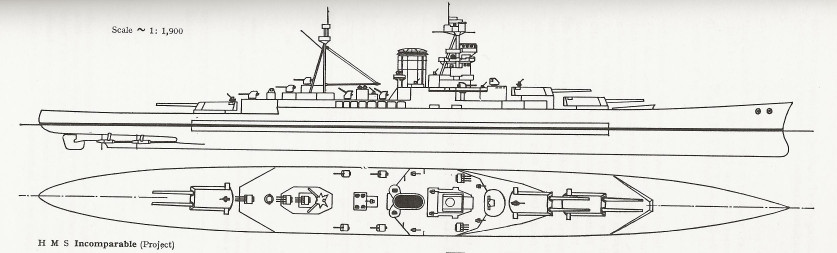
Breyer's problematical drawing
| USN | the
Wells Brothers' Battleship Index
Debunking the Incomparable (1915)By David R. Wells Version 1.2 |
| British (RN) | |
| Japanese (IJN) | |
| German (HSF & KM) | |
| Russian & Soviet | |
| French | |
| Italian |
The battlecruiser Incomparable was Admiral John Arbuthnot "Jackie" Fisher's last battlecruiser project. While the ship never even came close to beginning construction, it is nevertheless historically interesting because it is in some ways the ultimate expression of Fisher's battlecruiser concept. It is also the largest and most powerful battlecruiser proposal of its era. She would not have been a conventional battlecruiser, though, as she was designed for Fisher's Baltic Plan.
This is a tricky topic because there is not much solid information. Fisher seems to have changed his mind frequently, and there may not even be a "final" design. Several well-known illustrations have demostrable flaws.
Further, the ship may have been still being designed in the spring of 1915 when Fisher resigned as First Sea Lord. It is entirely possible that some information was lost during his departure.
I have been frustrated over the years by the lack primary source citations in published and on-line resources. I am attempting to remedy this situation by using Fisher's own writings. We do have one source of information that is as close as we will probably get to a primary source: Fisher's own writings in his book "Records". While it does not provide any final drawings, it does contain at least some information that other better-known sources don't.
While I have heard reports of Fisher's other papers with additional information, I have not seen these original papers, and I will not use data from them until I see them.
Admiral John Arbuthnot "Jackie" Fisher was an important figure in the Royal Navy in the years before World War I, and again during 1914-15. Fisher worked his way up through the ranks of the Royal Navy and retired as an Admiral on 25 January 1910, after serving as First Sea Lord, (from 21 October 1904) the highest position in the Royal Navy. During his return to the Admiralty, (29 October 1914 to 15 May 1915) he acted as a mentor to the young First Lord of the Admiralty, Winston Churchill. Fisher was a polarizing figure, with many loyal allies and probably as many bitter enemies.
Among his many achievements were HMS Dreadnought, a single ship which completely redefined the battleship, and HMS Invincible the first battlecruiser.
Fisher was a great believer in technological innovation. HMS Dreadnought had two major innovations: all "big gun" armament (i.e. eliminating the medium guns in favor of more main guns) and steam turbine propulsion. As time went on, he advocated abandoning coal as a fuel (in favor of oil) and diesel engines. He consistently wanted to get rid of old ships and old technology in favor of all new ships and technology.
Fisher was also a major advocate for organizational change in the Royal Navy, much to the consternation of his enemies.
While Fisher is most often remembered for his capital gunships, he was also a strong advocate for submarines and torpedoes. He firmly believed that the submarine would be the "Battleship of the Future". 1
Robert K. Massie's 1991 book "Dreadnought: Britain, Germany and the Coming of the Great War" (chapters 23-26) is an excellent source of biographical information on Fisher.
Fisher's battlecruisers were a new catagory of warship in the years leading up to World War I. They were an attempt to combine the firepower of a battleship with the speed of a cruiser. Battleship guns were mounted on an enlarged cruiser-style hull. However nothing is free, especially not speed. The British chose to save weight by reducing armor.
Battlecruisers were originally intended to hunt down and defeat armored cruisers, which were still quite common during World War I. When the battlecruisers were used as intended, as during the First Battle of the Falklands, (7 Dec 1914) they were quite successful. Problems arose when people assumed that they were just like battleships, only faster. When battlecruisers fought battleships, the results were usually very bad for the battlecruisers.
Three British battlecruisers exploded and sank during the Battle of Jutland. (31 May-1 June 1916)
The battlecruiser Hood famously exploded and sank during the Battle of the Denmark Strait (24 May 1941) while fighting the German battleship Bismarck.
In retrospect, the idea was probably not a good one. It would have required a large Royal Navy fleet to sail past Germany (and the German High Seas Fleet) into the Baltic Sea to Russia, and then back through the Baltic to Germany to conduct an amphibious operation. To the best of my knowledge, the Russian army of the time had no experience with amphibious operations. The British certainly assumed that the German High Seas Fleet would be either defeated at sea by the Royal Navy, or immobilized by a mining operation. History has demonstrated that neither assumption was very good. While the Battle of Jutland (May 31-June 1 1916) was an imporatant strategic victory for Great Britain, it did not destroy or immobilize the High Seas Fleet. Indeed, the British lost more capital ships than the Germans did.
At least three of these "Large light cruisers" were built for this purpose: the Courageous, Glorious, and Furious. They were armed with very heavy guns, but they were very lightly armored. Unlike the monitors, the "Large Light Cruisers" were very fast. Courageous and Glorious were armed with four 15" guns in two twin turrets, much like those on British battleships of the day. The Furious was designed for two 18" guns in two single turrets. The Furious was not completed as designed. She had a small flight deck added in place of her forward turret, and became one of the Royal Navy's first aircraft carriers. The Furious' 18" gun was an unusually short-barrelled design, only 40 calibres long.
From Fisher's own writings, 3 we can be certain that he intended for the Incomparable to be part of his Baltic Plan. It thus seems likely that his design for the Incomparable would have been more akin to the large light cruisers than to the more typical British battlecruisers.
Fisher resigned in May 1915 in the wake of the Gallipoli disaster, and the Baltic Plan was never tried.
An interesting addendum: There was a comparable plan in World War II known as "Operation Catherine" but it too was abandoned.
It is interesting to note that many reliable texts on British battleships and battlecruisers do not mention the Incomparable project at all. R.A. Burt, Norman Friedman, and even Oscar Parkes himself did not include this project in their well-regarded books about British capital ships. One theory is that the Incomparable was never an official project, and so was excluded from these texts.
Many of the publicly available sources that do discuss the Incomparable design are not ideal. Most of us learned of the Incomparable project from Sigfried Breyer's classic volume Battleship and Battlecrusers: 1905-1970. 6 Indeed several other sources seem to have copied their data from Breyer.
Breyer's problematical drawing
Breyer also gives some statistics that are problematical. I have seen nothing in Fisher's writings that would indicate an 11 inch (28cm) armor belt. Also, there is nothing that would suggest steam turbines or 180,000 shaft horsepower. Indeed, as we will see below, Fisher was quite interested in diesel engines at the time.
I don't want to criticize Breyer too harshly. As noted elsewhere, he was doing the best he could with the information available in Berlin in 1970. We simply have better resources now.
From Fisher's "Records", we can get a good, if imperfect view of what he had in mind.
The Incomparable design process started around 1912. 4 Fisher (pg 190) refers to a "descriptive outline set forth in the early morning of September 17th 1912". It is interesting to note that Fisher was retired from the Royal Navy at that point, so the design was certainly unofficial.
There seems to be some consensus that Fisher kept the idea alive when returned to the Admiralty in 1914.
Sigfried Breyer wrote that the project was completed in the Spring of 1915, when Fisher left the Admiralty again. 5
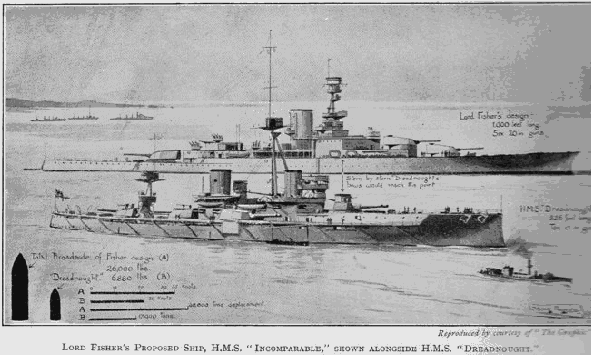
This illustration is well-known, if only because a scan was used by Wikipedia. The Wikipedia version has relatively poor resolution.
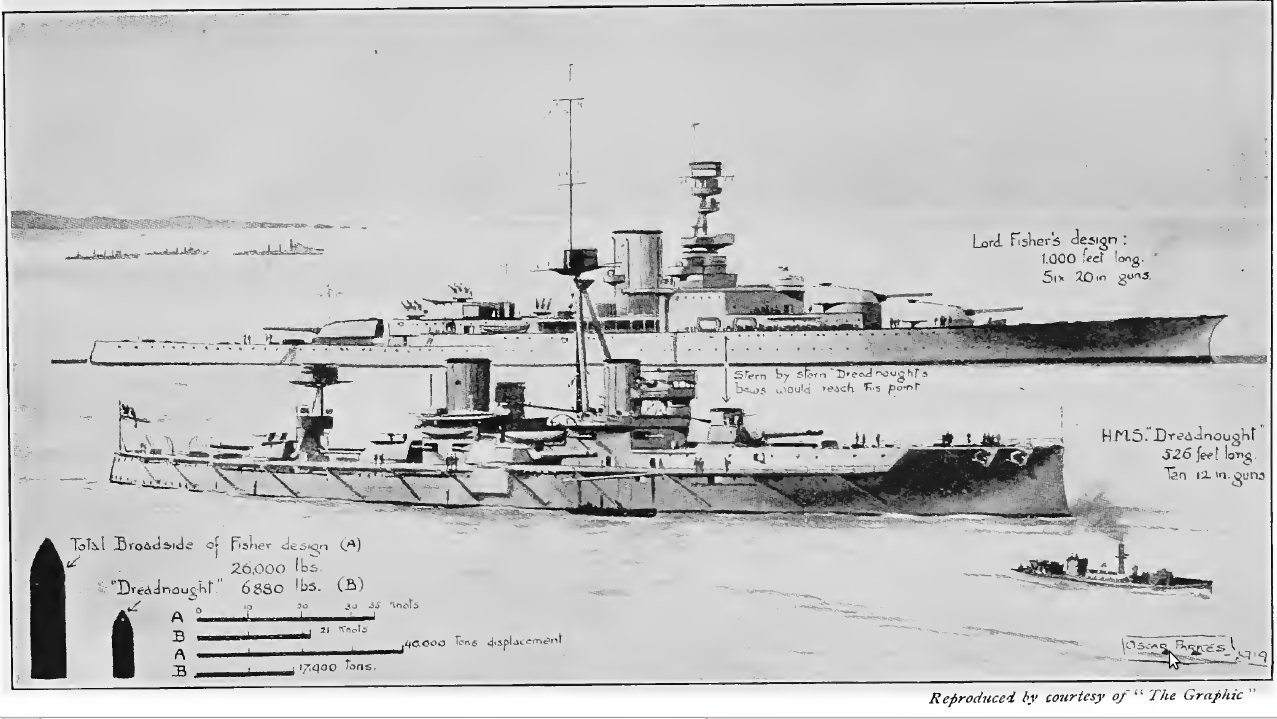
I made this one from Fisher's book. Note that the writing is clearer, and the name of the illustrator is clear. It is by none other than Dr. Oscar Parkes, author of the weighty tome "British Battleships, 1860-1950" and also a watercolorist noted for his paintings of warships. He served aboard the battleship HMS Agincourt during World War I.
Parkes clearly knew something of battleships, and he was also one of Fisher's followers.
Fisher wrote : In this connection I append a rough sketch by Oscar Parkes of a twenty-inch gun ship (see opposite). The sketch will offend the critical eye of my very talented friend, Sir Eustace Tennyson d'Eyncourt, but it's good enough for shoregoing people to give them the idea of what, but for the prodigious development of Air-craft, would have been as great a New Departure as was the "Dreadnought." The shells of the " Incomparable " fired from her twenty-inch guns would each have weighed over two tons ! Imagine two tons being hurled by each of these guns to a height above the summit of the Matterhorn, or any other mountain you like to take, and bursting on its reaching the ground far out of human sight, but yet with exact accuracy as to where it should fall, causing in its explosion a crater somewhat like that of Vesuvius or Mount Etna, and consequently you can then easily imagine the German Army fleeing for its life from Pomerania to Berlin. The "Furious " (and all her breed) was not built for Salvoes ! They were built for Berlin, and that's why they drew so little water and were built so fragile, so as to weigh as little as possible, and so go faster. 8
We can be certain, then, that the Parkes illustration is not completely accurate, but it is the only one I've ever seen that is roughly contemporary. It also is the only one I know of that has at least a partial endorsement from Fisher himself.
I am lead to wonder, though, if Parkes might have been more realistic than Fisher himself. Fisher certainly imagined a diesel powered ship with no funnel. In the World War I era, this might not have been practical for a relatively light, high-speed ship. At the time, marine diesels were in their infancy, and were noted for being relatively heavy with relatively low power. Steam turbines might have been needed to achieve the desired speed. Further, most diesel powered warships that appeared later did have funnels.
Fisher also clearly wanted a ship with very little superstructure and only a lightweight pole mast. It is unclear to how they would have handled long range fire control without some sort of taller tower for gun directors.
Parkes illustration shows design influences from the battlecruisers Repulse and Renown, as well as from the "large light cruisers" Courageous and Glorious. Since those ships were actually built, it seems reasonable that Parkes' illustration might be a more practical vision of what a real ship would have looked like. If the profile of the ship were indeed as Parkes suggested, (not a good assumption) given that the Incomparable design was roughly contemporary to HMS Repulse and HMS Courageous, I strongly suspect that the superstructure plan would have been more like that on those ships.
You can read it here
This incomplete article does not include references, so I cannot verify his sources of information. I therefore maintain an agnostic position towards its content. I make no claims about its accuracy or inaccuracy.
| Version | Date | |
| Version 1 | 1.0 | 23 March 2023 |
| Version 1.1 | 1.1 | 25 March 2024 |
| Version 1.2 | 1.2 | 28 November 2025 |
1 Fisher, John A. "Records" Hodder and Stoughton, 1919, London, New York, Toronto , pp 180
1 Massie, Robert K. "Castles of Steel: Britain, Germany and the Coming of the Great War" Random House, 1991, New York, Toronto , pp 296-297
2 Fisher, op. cit. pp 208-209
4 Fisher, op. cit. pp 190
5
Breyer, Siegfried: "Battleships and Battlecruisers 1905-1970", (English translation by Alfred Kurti) New York, Doubleday & Company, 1973, New York, pp 172
Breyer, Siegfried: "Schlachtschiffe Und Schlachtkreuzer 1905-1970", (German original), J.F. Lehmanns Verlag, 1970, Munich, pp 192
6 Breyer, loc. cit.
7 Fisher, op. Cit, pp 190
8 Fisher, op. Cit, pp 208
Copyright ©2019-2025 David R. Wells. All rights reserved.