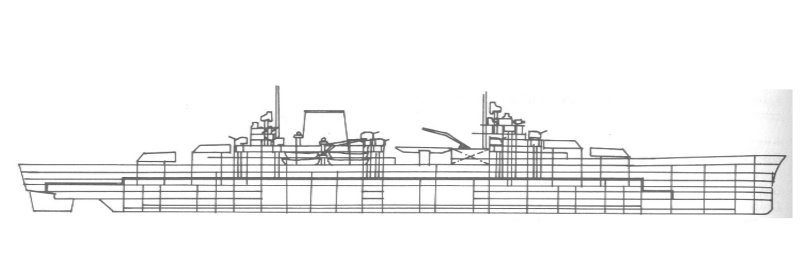
The 66,000 ton "slow" version of the Maximum Battleship of 1934
| USN | the Wells Brothers' Battleship Index
Debunking the Super Montana Class (BB-72-78)By David R. Wells Version 0.1 |
| British (RN) | |
| Japanese (IJN) | |
| German (HSF & KM) | |
| Russian & Soviet | |
| French | |
| Italian |
At the risk of giving away the conclusion at the beginning, there was no "Super Montana" class. Ordinarily, I would say that this particular sea story should be considered with all the seriousness given to tales of mermaids and sea monsters. Yet the Super Montana myth has persisted for decades, so it does need debunking.
Most of the well-known texts on US battleships don't mention the "Super Montana" class at all. This is appropriate in most regards, as these books are intended to be factual, and do not need to deal in myths.
This page will attempt to explore the origins of the Super Montana myth, examine some of the reasons the tale has so stubbornly persisted, and point to somewhat more real designs that might have been sources for some of the mythology.
The Montana class was the US Navy's last official battleship design.
While the design was entirely real, construction of these ships was never even begun. The design process started in late 1939, with a series of sketch designs known as BB65-A through J. A series of preliminary designs known as BB65-1 through 13 were drawn March through June of 1940. BB65-5B was selected for further development, and the detailed designs BB67-1 through 4 were completed November 1940 through January 1941. Design work continued as late as June 1942. The Montana-class battleships were cancelled on 21 July 1943.
Unlike the preceeding fast battleships of the Iowa-class, (BB-61 through 66) the Montana-class were to be conventional battleships, emphasizing protection over speed. They would have had twelve of the powerful 16"/L50 Mk 7 guns in four triple turrets. The planned secondary battery was also notable: twenty of the new model 5"/L54 guns in ten twin Mk 41 mounts. Armor protection was also impressive. For example, the main belt armor would have been over 16" thick. Speed, however, was limited to 28 knots.
There was no successor design.
As with modern internet myths, rumors promoted by media sources in the past can be difficult to trace to their origins. Then as now, some publications were more reliable than others. Reliable modern texts tend not to include old false rumors.
One of the few reliable sources to discuss the topic is Norman Polmar, and even he doesn't go into much depth. According to Polmar, the legend of the Super Montanas (BB-72 through 78) goes back to bad press reports. It seems likely that these reports were from the late 1940s.
Polmar writes: "There was speculative press mention of a 'super MONTANA' class of some 80,000 tons mounting 20-inch (508-mm) guns with the hull numbers BB-72 to 78; in fact no battleships beyond the MONTANAS were formally considered by the US Navy." 1 From my readings on the subject, I believe that Mr. Polmar is correct, however I have not been able to find the press reports that he mentioned. If anyone knows where they are, please let me know.
There are three real ship designs that I can think of that might have contributed to the Super Montana myth: The "Maximum Battleship" of November 1934 (fast version), the BB65-8 design study, and the July 1944 design study. Each has some characteristics that are comparable to the Super-Montana legend.
On careful examination, though, it is clear that none of them alone could have been the sole source of the rumor.
Probably the closest thing to Polmar's description is the "Maximum Battleship" of November 1934, (fast version). This design study called for an 72,500 ton ship with eight 20-inch guns, which is close to Polmar's description. If the 72,500 ton figure is a "standard" displacement, 80,000 tons full load is within range. At least at first glance, this matches Polmar's description.
There was also a smaller, slower design with the same armament.
These were design studies meant to investigate what sorts of ships might be built if Japan broke out of the Washington/London treaty system.
Norman Friedman's US Battleships: An Illustrated Design History provides the best data we've found on these design studies. (pp 239-240)2
Unfortunately, I have not been able to find a drawing of the fast version of this maximum battleship.
The specified 20" gun was never designed. It did not even exist on paper. The statistics for the design study were extrapolated from existing 16" and 18" designs.
It should be obvious that the Maximum Battleship of 1934 design study could not possibly be a "real" Super Montana, because it long predates any Montana design.
| "Maximum Battleship" of 1934 (fast version) | |
| Dimensions | |
| Displacement (standard??) | 72,500 |
| Length: (wl??) | 975' |
| Beam: | 107' |
| Draft: | 37' |
| Machinery: | 220,000 SHP, 30 knots |
| Armament | |
| Main | eight 20" guns (twin turrets) |
| Secondary | twenty 5" guns (twin mounts) |
| Anti-aircraft | Sixteen 1.1" AA guns |
| Armor: | |
| Belt: | 16" |
| Barbettes: | 16" |
| Armor deck: | 6.5" |
| Splinter Deck: | 1.5" |

A more realistic source for the "Super Montana" rumor might be design study BB65-8 from 1940. At 70-82,000 tons, she is closer to the 80,000 ton rumored displacement. BB65-8 also has the historical advantages of being part of the Montana design process, and being reasonably well documented.
Once again, Norman Friedman's US Battleships: An Illustrated Design History provides the best data we've found on this design study. 3
| Battleship design BB65-84 | |
| Dimensions | |
| Length: | 1050' |
| Beam: | 120' (wl) |
| Beam: | 125' (below waterline) |
| Standard Displacement: | 70,000 tons |
| Trial Displacement: | 82,000 tons |
| Machinery: | 320,000 SHP, 33 knots |
| Armament | |
| Main | twelve 16"/L50 Mk 7 guns (triple turrets) |
| Secondary | twenty 5"/L54 Mk 41 guns (twin mounts) |
| Armor: | |
| Belt: | 15.75", angled at 19 degrees |
| deck: | 6.2" |
One nice thing about BB65-8 is that I do have an actual US Navy Preliminary Design drawing of it. Also, as we will see below, Superior made two 1/1200 aluminum model kits based on this ship.
As interesting as she is, BB65-8 could not be the "Super Montana". BB65-8 was designed as part of the preliminary design process in Spring 1940, well before the Montana design was finalized in 1942. BB65-8 is a predecessor to the Montana-class, not a successor.
Apparently, there was one final USN battleship design study. This design study was never intended to produce a real battleship. It was merely a study to determine how big a battleship would have to be in order to be properly protected against (then) modern weapons, especially torpedoes. In that respect, this study is comparable to the Germans' later H-class studies. The dimensions were dictated by the size of the proposed new locks for the Panama Canal. This design study never even made it to the Preliminary Design phase. We have not seen a drawing for it, though there might be a rough sketch somewhere.
The best source I have found for this design study (indeed the only source) is Dulin & Garzke's Battleships: United States Battleships 1935-1992, pg 165-166. Their writings on this design are remarkably short.
| July 1944 Design Study6 | |
| Dimensions | |
| Length: | 1160' WL, 1200' OA |
| Beam: | 136' (wl) |
| full load Displacement: | 106,500 tons |
| Draft: | 38' |
| Armament | |
| Main | twelve 16" |
Dulin & Garzke state that the displacement, draft, and main armament are their own estimates.
Although this design study was done after the Montana design was complete, and is much larger than the Montana design, it is almost certainly not the source of the Super-Montana legend. It does not match any of the numeric descriptions of the Super-Montana. Indeed the July 1944 design study was much bigger, so it is extremely unlikely to be the source of the rumor.
I certainly would never tell anyone not to build a model of a speculative battleship. Go ahead and buy one if you want.
But in the end, it is only a model. To the best of my knowledge, there was no 18-inch gun variant of BB65-8, nor of any other Montana-class variant.
I have a gentler opinion of these drawings than many others do. I hold that while they are certainly unofficial, they are not completely insane. This may be the subject of another webpage someday.
While this drawing does show an evolution of the Montana-class into the post World War II era, Wiswesser makes it clear that this is a revision of BB-67, and not a new class. It also does not match the original description of the Super Montana. Wiswesser's drawing indicates as (standard?) displacement of 60,500 tons rather than 80,000 tons. Wiswesser's drawing also retains the Montana-class' main armament of twelve 16-inch/L50 Mk 7 guns, with no trace of a 20-inch gun. Thus, Wiswesser's drawing is not the origin of the Super Montana legend.
An anonymous friend for his help with the Blue Ridge kits, and several editing suggestions.
| Version | Date | |
| First Draft | 0.0 | 25 February 2026 |
| Second Draft | 0.1 | 14 March 2026 |
1 Polmar, Norman " The Naval Institute Guide to the Ships & Aircraft of the U.S. Fleet", 17th ed. Naval Institute Press, Anapolis, MD 2001, pp 128
2 Friedman, Norman " U.S. Battleships: An Illustrated Design History" Naval Institute Press, Annapolis, MD 1985 ISBN 0-87021-715-1, pp 239-240
3 Freidman, op. cit. pp 336-337
4 Friedman, op. cit. pp 337
5 Friedman, op. cit. pp 333
6 Dulin, Robert O. & Garzke, William H. "Battleships: United States Battleships 1935-1992" Naval Instutute Press, Annapolis MD 1995 ISBN 1-55750-174-2 pp 165-166
Copyright ©2019-2026 David R. Wells. All rights reserved.