The tale told by Amare Gizaw to the members of the First Presbyterian Church about the plight of the Ethiopian people ushered in the birth of American Outreach to Ethiopia (AOE).
After living twenty-seven years under the brutal rule of two successive dictatorial regimes, Amare was compelled to flee his native Ethiopia and come to America. He had received his formal education in the United States and believed that true help for his country would now come from the compassionate and generous people of America.
Pastor John Kay, D. Min., touched by the tragedy of Ethiopia, joined Amare in leading sessions to organize AOE. Other leading participants in the making of AOE were Samuel Stuart, M.Div., Attorney Larry Kuster, Col. B. Wayne Quist, Phyllis Fenton, Matt and Katy Boley.
American Outreach to Ethiopia was incorporated in 2005 and is certified by the IRS as a 501 (c) (3) non-profit organization.
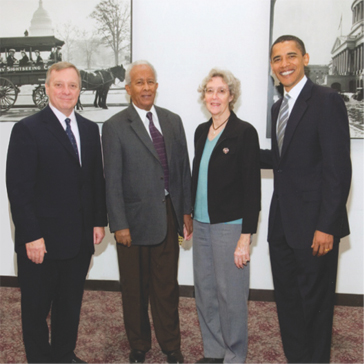
From left to right Senator Dick Durbin, Amare Gizaw, Dorothy Amare and President Barack Obama
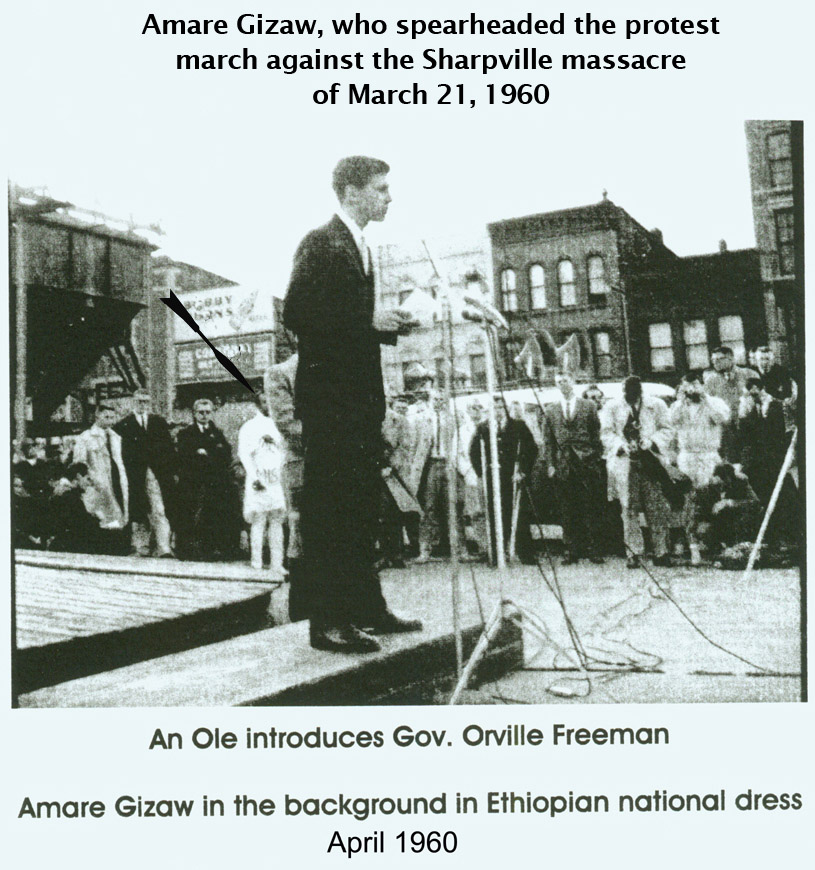
Amare Gizaw's heartrending story of decades of struggle, sacrifice, and personal denial is extraordinary. In the fall of 1956, Amare enrolled as a freshman at St. Olaf College, Northfield, Minnesota where he majored in political science and history.
In 1954 Emperor Haile Selassie came to America as an official guest of President Eisenhower. After the White House ceremony he came to visit St. Olaf College, accompanied by the American Ambassador to Ethiopia, Joseph Simonson, an alumnus of the college. Dr. Granskou, the college president, offered the Emperor one scholarship which was won by Amare.
As a student Amare played an instrumental role in bringing together St. Olaf and Carleton College students in a joint protest demonstration against the 1960 Sharpeville Massacre in South Africa. The massacre marked the beginning of South African democracy when Nelson Mandela, who had his military training in Ethiopia, rose up against the apartheid regime. Students from both colleges marched together in Minneapolis and listened as Minnesota Governor Orville Freeman addressed the assembly.
After leaving Northfield in 1960 Amare enrolled as a graduate student at American University in Washington, DC. While in Washington he worked as manager of Africa House, of the African-American Institute, helped form the Ethiopian Student Association, worked with Sargent Shriver in the Kennedy Administration to help establish the Peace Corps, and met with President Kennedy in the Oval Office. He returned to Ethiopia in 1963, inspired by American democratic ideals and full of hope for improving the lives of his fellow Ethiopians.
Amare's dream of transforming Ethiopia into an America-style democracy, however, was dashed as conditions deteriorated shortly after his return home. When famine struck Ethiopia's two northern provinces in 1973, Amare worked with western missionaries to provide food, medicine, and clothing to the needy. When the famine worsened, Amare sought help in London, arriving just as Jonathan Dimbleby of the BBC released the film that shockingly displayed to the world the horror of the Ethiopian famine. With Dimbleby, NGOs and friends of Ethiopia, Amare was again able to raise funds and ship food and medicine to Ethiopia.
Following the coup in 1974, Amare returned to Ethiopia and was recruited for a senior position in the interim government. When Mengistu seized control his lieutenants murdered Haile Selassie and sixty government leaders and imprisoned hundreds of professional Ethiopians, Amare included. Amare's American friends tried to locate him at the time, but reports from the American embassy in Addis Ababa indicated that he had probably not survived the communist coup.
But Amare did survive, and despite imprisonment and severe beatings he was finally released from prison and continued his mission to help his fellow Ethiopians, this time combating wide-spread degradation of the environment under the communists who, having confiscated ownership of private lands, left the forests and trees unprotected from people seeking free firewood for cooking.
Conditions in Ethiopia deteriorated further, and in 2002 Amare finally escaped to the U.S., returning to his adopted land for the first time in nearly 40 years. Through decades of tragedy and disappointment, Amare maintained his Jeffersonian outlook and his St. Olaf idealism. Today he is a highly articulate spokesperson for Ethiopian freedom and democracy.